"Getting something tangible in front of customers used to take weeks of building."
Oh really? This claim is bananas. Sure, in many companies we've seen the pattern of teams only putting high-fidelity stuff in front of customers. But others have figured out that you could always get meaningful tangible stuff in front of customers in a matter of hours. Perhaps it's naive of us to expect that one of today's peak SV teams would've figured this out too.
The trick is simple but not easy. You mostly don't need to build much at all – you just have to use your damn brain and separate format from behaviour. See Hard Test, Easy Life.
Anyway, the real constraint isn't how fast you can pump out fancy prototypes. It's the tempo with which you, your team, and your wider organisation can reorient based on the signals you get from probing the real world with your prototypes.
Suffice it to say, even if you do manage to collapse the prototype-to-customer loop to an afternoon with help from AI, you may still find yourself watching in dismay while what you learned gathers digital dust in someone's inbox for three months. Why? Because everyone is busy manoeuvring through the dance of whose story wins, and how best to handle the fallout when Fred's team in the other division finds out.
Ultimately, it's the learning that always matters. But if your learning isn't driven by good effectuation and reorientation, it's going to proceed at the speed of politics, not the speed of AI.
Christina Wodtke shared a particularly sharp perspective: the focus on crazy speed happens to be exactly the right marketing tactic for LLM vendors as they land-grab the S&P 500. But here, speed is a tactic, not a goal. Other organisations probably shouldn't take Anthropic's tactical choice as a cue to adopt the same metrics.
Which brings us to the thing that's almost buried in the article but is actually way more important than raw speed.
2) The effectuation thing
"Instead of a long-term roadmap, we encourage everyone on the team (engineers, product managers, designers) to take on side quests. A side quest is a short self-directed experiment you run outside your official roadmap."
Once we've blown our noses and stopped being so sniffy, we have to agree that it's GREAT that they've been able to let go of visions and roadmaps and carry out something that's more like effectuation. This is vastly more important than the speed stuff — and vastly harder for most organisations to actually do.
However, the article frames this as sort of a ... nice bonus. "Some of our most popular features emerged this way." But what they're actually describing, without quite saying it, is a fundamental shift in how they relate to uncertainty. Instead of aligning on a vision and working backwards to list out features, Anthropic famously set a boundary ("let's focus on developers") and let their teams go explore wildly inside it.
This is what Ken Stanley calls the playground approach. (Recommendation here for his book, Why Greatness Cannot Be Planned: The Myth of the Objective.) Set no goal beyond "go figure out what you can do with the equipment in that playground over there". And from this, ideas emerge that you could never have figured out by working backwards from a vision.
Just for fun, let's contrast Anthropic with OpenAI, who appear to have been thrashing from vision to vision, throwing out such bangers as SlopTok and ScarJo-as-a-Service, and now the lurching pivot to an ad-drenched sexbot. Classy.
It just so happens that the idea that you don't necessarily need to align on a vision is a hill we are willing to die on at Crown & Reach. It's one of the most powerful ideas we've ever come across and we have talked about again and again and again. At the same time, it's also an idea that makes people's brains do the biological equivalent of the spinning Claude blob and the message "I'm having trouble thinking this through right now...".
The paradigm where you must set a vision and then work backwards is the murky water we fish are swimming in. And this paradigm works, sometimes. But when you're facing genuine uncertainty, ambiguity, complexity, the vision alignment game is a recipe for thrashing and stress. It's a trap! No wonder so many leaders can't let go of striving to find the right vision. You've probably seen this yourself over the past few years.
The answer most orgs need but can't easily shift to? Put boundaries around a playground and let the vision go blurry.
This is how you can enable speed of learning, speed of reorientation – speed that matters and changes an organisation's fate.
The Claude article gets tantalisingly close to landing this point. Then it pivots right back to the speed-of-making obsession. And that gives us a clue for the direction many organisations are going to go in over the coming months: chasing raw speed because effectuation is Just. Too. Weird.
Which brings us to how that raw speed is actually being used, and why it's actually a case of more haste less speed for most companies right now.
3) The "collaboration" thing
The third big rankle in the article is that all the "collaboration" described is really solo work. It's one person wearing a product manager hat collaborating with themselves wearing a designer hat and themselves wearing an engineer hat, like a Bugs Bunny cartoon where Bugs is all the characters.
That's not collaboration. It's a cartoon of collaboration. It creates a pastiche of the valuable artefacts that collaborative teams produce, and skipping the thing that made them valuable.
Cos the value wasn't ever in the artefacts themselves in the first place. It was in the friction you meet along the way.
Such as the developer who tells you something "can't be built like that" and you're frustrated but aha! they also accidentally revealed a deeper constraint that opened up a more elegant way forward.
Or the customer who annoyingly misunderstands your prototype in exactly the right way, unintentionally revealing a much better idea that you couldn't have thought of by yourself. You just can't get that from an AI tool that reflects back what you already think (while telling you how great and smart and original you are).
There seems to be something deep in tech culture's DNA that keeps trying to engineer away the need for actual human collaboration. Ew, it's messy and unpredictable and there are, like, feelings and stuff. Imagine if it could all be more like a computer program.
In the past, one dominant workaround for this (that was also very hard to break free from) was handoffs. Pavel Samsonov recently made a related argument about how design in particular had already weakened its service relationships long before AI arrived to finish the job.
Now AI tools seem to be the latest trick to let misanthropes avoid other humans. And they're devastatingly seductive. They are wired to make you feel like you've collaborated, like you've tested and honed your ideas, all the while disguising the fact that what you've really done is gaze into a machine-learning-powered mirror that's trained to tell you your ideas are AH-MAY-ZING BABY, presenting an impression of coherence, quality and rigour even when what's underneath the shiny surface is a hot mess.
That isn't a less-good version of real collaboration. It's actively worse, because it inoculates you against noticing what you're missing.
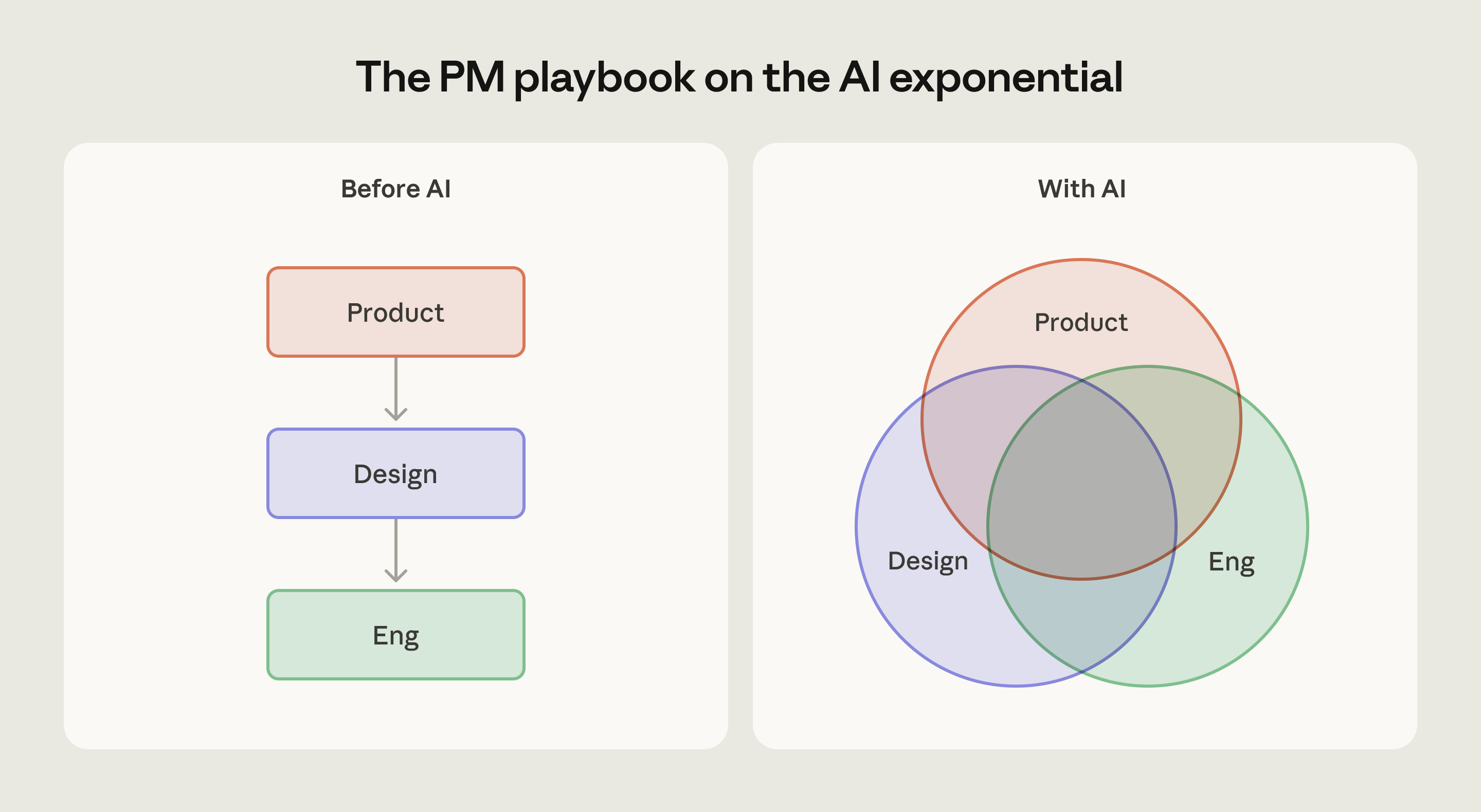
On a related note, Anthropic's drawing of product, design, engineering as sequential vs overlapping with the claim that "now with AI, it can all collapse" also struck us as bananas:
This is the diagram from Cat Wu's article. But we've been living over on the right hand side for over a decade – without using AI tools.
Again, the best teams we've worked with have (admittedly sometimes after significant effort) managed to get the circles to overlap. And this has been the case for over a decade and without AI.
So, where does this leave us?
With employees prototyping faster and faster by themselves, always feeling like they're close to finally "cracking it", while the decisions continue to proceed at the speed of politics. Of course. Because that was always the real bottleneck.